
Explore Major Theories
This section highlights key theories, showcasing creativity, expertise, and the value delivered through our work.

The Theory of Saturation as a Meta-Framework
The Theory of Saturation is a meta-theoretical framework designed to analyze how individuals, institutions, and complex systems respond when increasing demands exceed their capacity for meaningful processing, decision-making, and adaptation. Rather than focusing on isolated failures or singular crises, the theory examines saturation as a systemic condition that emerges through accumulation, overload, and unresolved complexity. It provides a structured lens for understanding why systems persist in ineffective patterns, resist change, or gradually move toward stagnation or collapse despite clear signals of dysfunction.
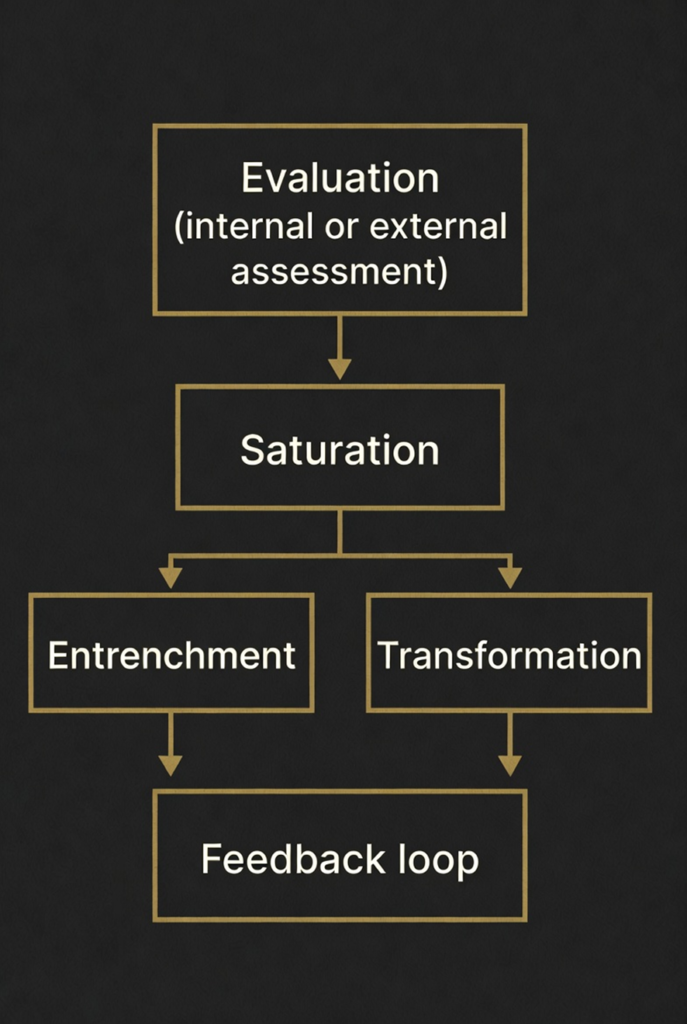
At its core, the Theory of Saturation operates through an integrated sequence of assessment, saturation, lie, and solution. Assessment refers to the system’s recognition—explicit or implicit—of mounting pressure or imbalance. Saturation occurs when the system’s capacity is exceeded and effective responses become constrained. In this phase, systems often generate a “lie”: a stabilizing narrative, symbolic action, or superficial adjustment that creates the appearance of control without resolving underlying structural limits. Solutions, when they emerge, may either be genuine—requiring transformation and desaturation—or illusory, reinforcing saturation through repetition. Between these stages, systems pass through intermediate states such as avoidance, compromise, and partial collapse, reflecting attempts to delay or soften the consequences of saturation without confronting its root causes.
A critical dimension of the Theory of Saturation is its emphasis on feedback loops. Decisions made under saturation feed back into the system, often increasing pressure, narrowing future options, and reinforcing defensive behaviors. Avoidance generates more complexity, compromise institutionalizes inefficiency, and collapse—whether partial or localized—reshapes the system’s capacity and constraints. These feedback loops explain why saturation is rarely linear and why reform efforts frequently fail when they do not address structural capacity rather than surface symptoms.
As a meta-framework, the Theory of Saturation is applicable across multiple scientific and scholarly domains. In psychology, it provides insight into burnout, cognitive overload, and decision fatigue. In sociology and political science, it explains institutional inertia, legitimacy crises, and revolutionary thresholds. In economics and management studies, it sheds light on organizational rigidity, market exhaustion, and innovation stagnation. In systems theory and complexity science, it aligns with threshold dynamics, non-linear transitions, and systemic breakdown. By integrating these perspectives within a single conceptual structure, the Theory of Saturation enables cross-disciplinary analysis of crisis, stagnation, and transformation, offering a common language for diagnosing systemic limits and exploring pathways toward sustainable change.

Geometry of Collapse
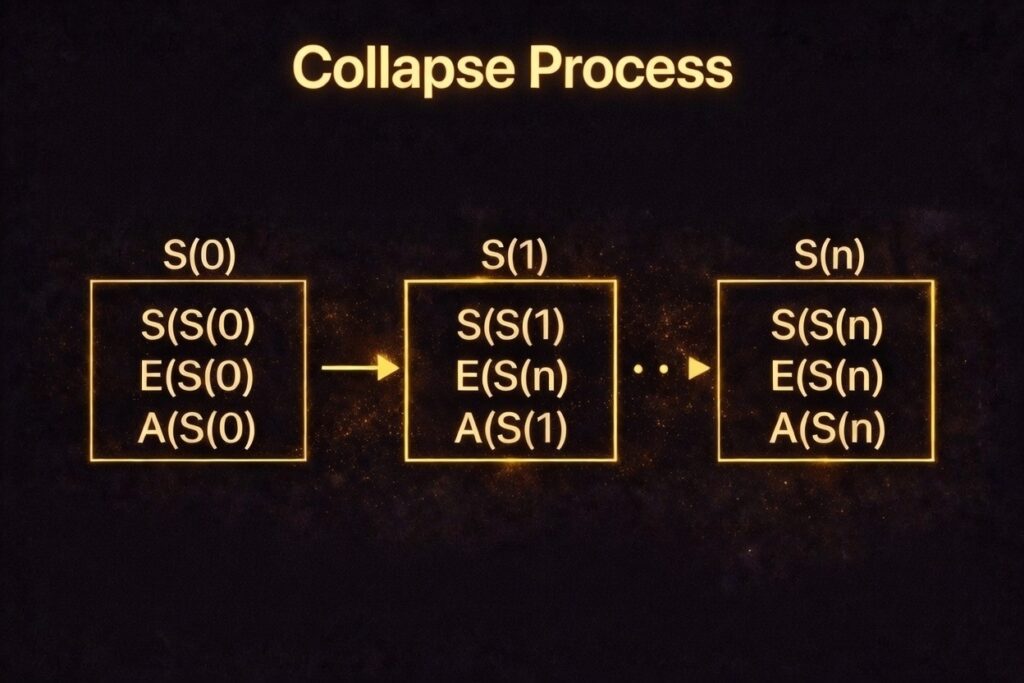
The Collapse Model (also known as the SEA Model) provides a unified framework for understanding the rise, saturation, and potential collapse of civilizations. It identifies the core forces that drive civilizational trajectories: energy flows, complexity buildup, temporal dynamics, and systemic interconnections.
At its heart lies Saturation Pressure (S), a composite measure of accumulated stress arising from density, acceleration, and tight coupling. When S exceeds a civilization’s adaptive reserves, fragility increases, and collapse becomes more likely—not as random failure, but as a predictable phase transition.
The SEA Framework
A simpler yet powerful lens views the model through three interdependent layers:
- S – Stability — The foundational layer (ecological base, resource metabolism, infrastructure, and basic social coherence). It provides the ground on which everything else stands. Erosion here—through depletion or overshoot—initiates collapse from the bottom up.
- E – Efficiency — The optimization layer (markets, bureaucracy, technology, and acceleration). It amplifies productivity and growth but creates rigidity, fragility, and the classic “efficiency trap” when pushed too far.
- A – Adaptability — The resilience layer (redundancy, flexibility, innovation, polycentric governance, and reflexive awareness). It allows systems to absorb shocks, reorganize, and evolve under stress. Strong A counters rising S and prevents brittleness.
Civilizations thrive when these layers balance: robust Stability supports efficient growth, while high Adaptability preserves slack and options. Collapse occurs when Efficiency overwhelms Stability and suppresses Adaptability, driving Saturation Pressure beyond recovery thresholds.
Implications and Hope
This SEA perspective reveals why collapse is often inevitable in late-stage systems yet not predetermined. By measuring and monitoring these dynamics in real time, we gain the ability to intervene—restoring temporal diversity, rebuilding slack, and fostering reflexivity—to steer toward transformation rather than terminal convergence.
The model offers not just diagnosis, but a pathway: strengthen A, rebalance E with S, and avert the saturation trap before it locks in.

Rosetta Stone Model
The Rosetta Stone Model is a groundbreaking quantitative framework designed to unify the fragmented study of civilizational dynamics. Just as the original Rosetta Stone unlocked the translation of ancient Egyptian hieroglyphs by providing a common key across three scripts, this model serves as a “translation layer” that maps diverse signals from ecology, economics, governance, culture, and temporal systems into a shared set of measurable variables.
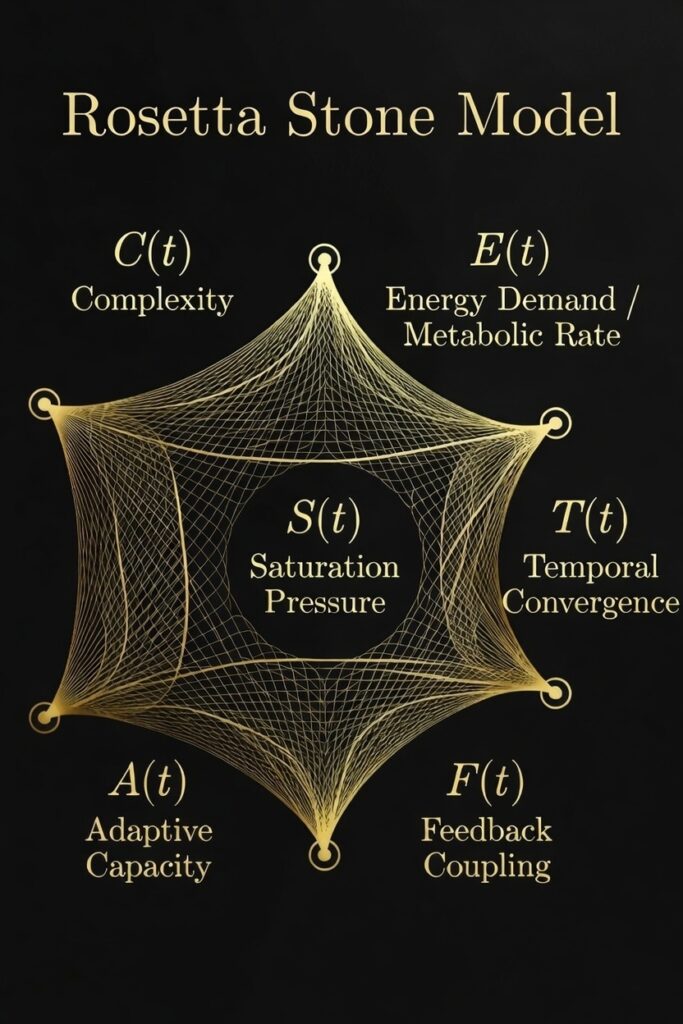
At its core, the model tracks Saturation Pressure (S(t)), a single composite indicator that quantifies the accumulated systemic stress threatening a civilization’s stability. Saturation Pressure arises from the interplay of rising complexity, accelerating temporal rhythms, tightening global feedback loops, and metabolic demands outpacing ecological limits. When S(t) consistently exceeds adaptive capacity, the system approaches critical thresholds, making rapid phase shifts—or collapse—structurally probable.
Why “Rosetta Stone”?
Historical collapse theories have long suffered from silos: ecologists focus on resource depletion, economists on inequality, political scientists on institutional failure, and cultural analysts on meaning-loss. The Rosetta Stone Model overcomes this by providing a universal grammar—six core variables (complexity, energy demand, temporal convergence, feedback coupling, adaptive capacity, and saturation pressure)—that translates all these domains into comparable, real-time metrics.
This enables, for the first time, a predictive dashboard capable of monitoring planetary-scale fragility as it emerges, rather than analyzing it only in hindsight.
Measuring Saturation Pressure
Saturation Pressure is not a vague concept but a rigorously calculated index derived from publicly available global data. It combines proxies for density, acceleration, and coupling into a bounded score (typically 0–1), where values above ~0.75–0.80 have historically preceded major civilizational crises.
By making saturation measurable in real time, the model transforms collapse from an inevitable historical pattern into a controllable variable. Early detection of rising S(t) opens windows for deliberate interventions—such as restoring temporal diversity or rebuilding systemic slack—potentially steering humanity away from terminal convergence toward sustainable reconfiguration.
The Rosetta Stone Model offers not fatalism, but foresight: a scientific tool to diagnose, monitor, and ultimately manage the deep forces shaping our shared future.
Belief Investment Lock-in Theory (BILI)
The Belief Investment Lock-in Theory (BILI) explains why individuals, groups, organizations, and political systems often resist substantial revision even when reality increasingly contradicts their beliefs or established narratives. The theory argues that over time, beliefs accumulate both symbolic investments—such as identity, morality, belonging, memory, legitimacy, and emotional attachment—and material investments, such as careers, institutions, infrastructure, reputation, economic interests, and power structures. As these investments deepen, the perceived cost of changing or abandoning the belief rises dramatically. Under conditions of saturation, revision is no longer experienced as a simple intellectual correction; it becomes a threat to identity, stability, legitimacy, and structural continuity.
BILI proposes that distortion, selective interpretation, narrative preservation, and defensive reconstruction often emerge not merely from irrationality or intentional deception but from mechanisms of structural self-preservation. When the perceived costs of revision exceed the tolerable threshold of disruption, systems tend to protect themselves by adapting narratives rather than fundamentally transforming underlying beliefs. By integrating insights from behavioral economics, cognitive dissonance theory, sociology, personality psychology, and philosophy of science, BILI provides a multi-level framework for understanding resistance to change across psychological, social, institutional, ideological, and political domains.

See orientation note 4 . https://manafi-institute.de/Resources/
© 2026 Manafi Research Association. All rights reserved