
Ray Dalio’s economic framework can be understood as a contemporary, empirical articulation of saturation dynamics within large-scale financial systems. His analysis of long-term debt cycles treats economies not as equilibrium-seeking mechanisms but as adaptive systems structured by feedback loops. In periods of expansion, borrowing, asset appreciation, and confidence reinforce one another, producing rapid growth. Over time, however, this very success generates fragility: debt outpaces income, financial instruments multiply beyond productive capacity, and policy responses become increasingly reactive. At this stage, the system enters a condition of economic saturation, where efficiency and optimization persist but adaptability declines. Growth continues mechanically, yet the system loses its capacity to absorb shocks or learn from accumulating distortions.
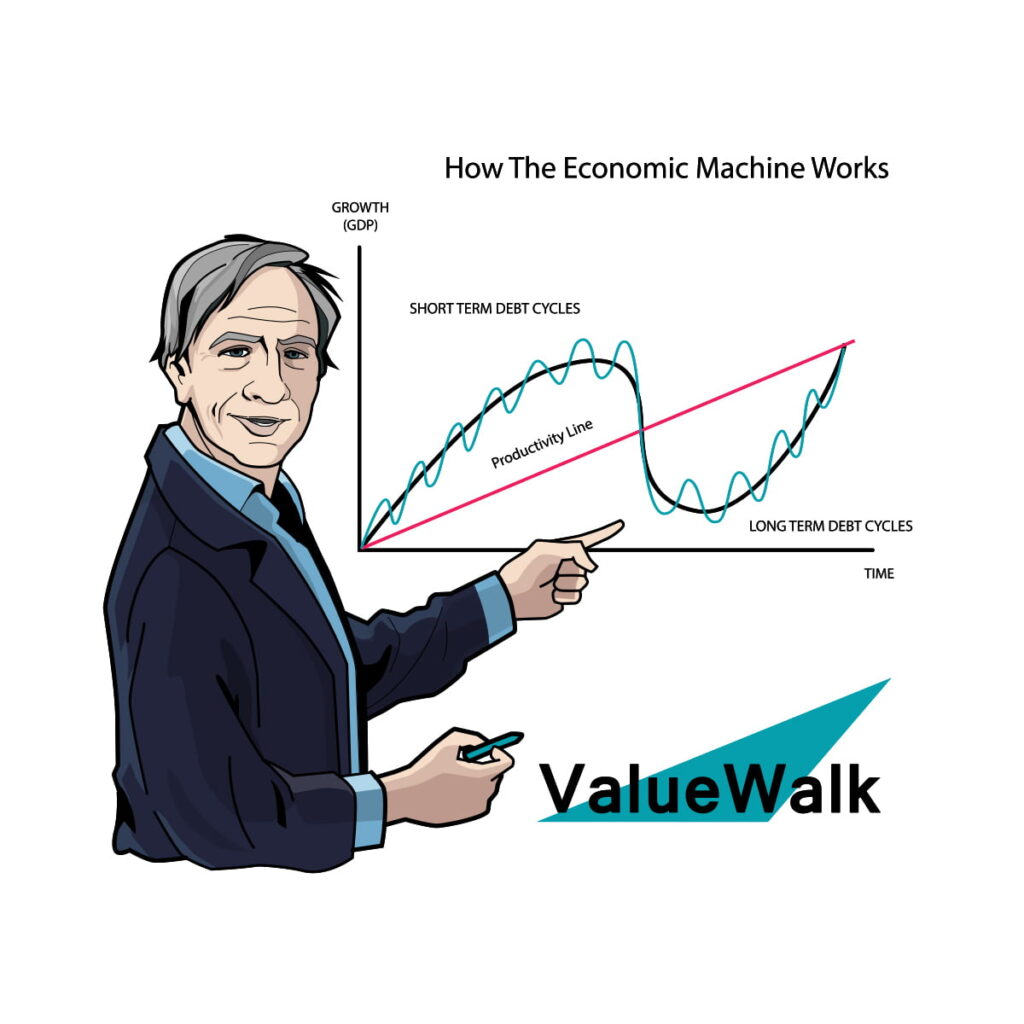
Crucially, Dalio does not interpret economic collapse as an external anomaly or moral failure, but as a structural consequence of unresolved feedback. When debt, inequality, and institutional rigidity suppress corrective signals, breakdown becomes the only remaining form of adjustment. From the perspective of saturation theory, this corresponds to the transition from delayed feedback to forced recalibration. Dalio’s emphasis on diversification, historical pattern recognition, and institutional reform reflects an implicit recognition that systems must preserve self-awareness to remain viable. Economies, in this view, are not merely financial arrangements but collective cognitive structures: when they mistake stability for permanence and optimization for resilience, saturation intensifies. Collapse, then, is not an endpoint but a systemic message—one that, if integrated, enables renewal rather than repetition.
-
Willard Van Orman Quine (1908–2000), a major figure in 20th-century analytic philosophy, rejected foundationalism and tightly linked philosophy to empirical…
-
Ray Dalio’s economic framework can be understood as a contemporary, empirical articulation of saturation dynamics within large-scale financial systems. His…
-
The collapse of the Soviet Union can be interpreted, through the Theory of Saturation, as a paradigmatic case of structural and…
-
January 6, 2026 Modern healthcare systems increasingly operate under a paradigm of relentless efficiency. Lean management, standardized protocols, performance metrics,…
-
According to the Collapse (SEA) Model, systemic failure occurs when Stability (S) and Efficiency (E) dominate at the expense of…
-
The Islamic Republic of Iran is undergoing a systemic collapse driven not by a single crisis, but by long-term saturation…
-
Leon Trotsky’s theory of permanent revolution can be read, through the lens of the Theory of Saturation, as a sophisticated…
-
Buddhism offers a distinctive perspective on saturation and collapse, one that operates not at the level of institutional failure or…
Leave a Reply