
The collapse of the Soviet Union can be interpreted, through the Theory of Saturation, as a paradigmatic case of structural and cognitive saturation. Initially adaptive mechanisms—central planning, ideological coherence, and rapid mobilization of resources—became increasingly rigid over time. The system optimized for control and stability at the expense of feedback sensitivity. Economic signals were distorted, dissent was suppressed, and ideological orthodoxy replaced adaptive learning. As a result, contradictions accumulated invisibly: productivity stagnated, innovation slowed, and legitimacy eroded. By the time reform was attempted, the system had already crossed a saturation threshold in which incremental correction was no longer possible. Collapse was not caused primarily by external pressure, but by internal exhaustion—a failure to metabolize complexity and respond to emergent realities.
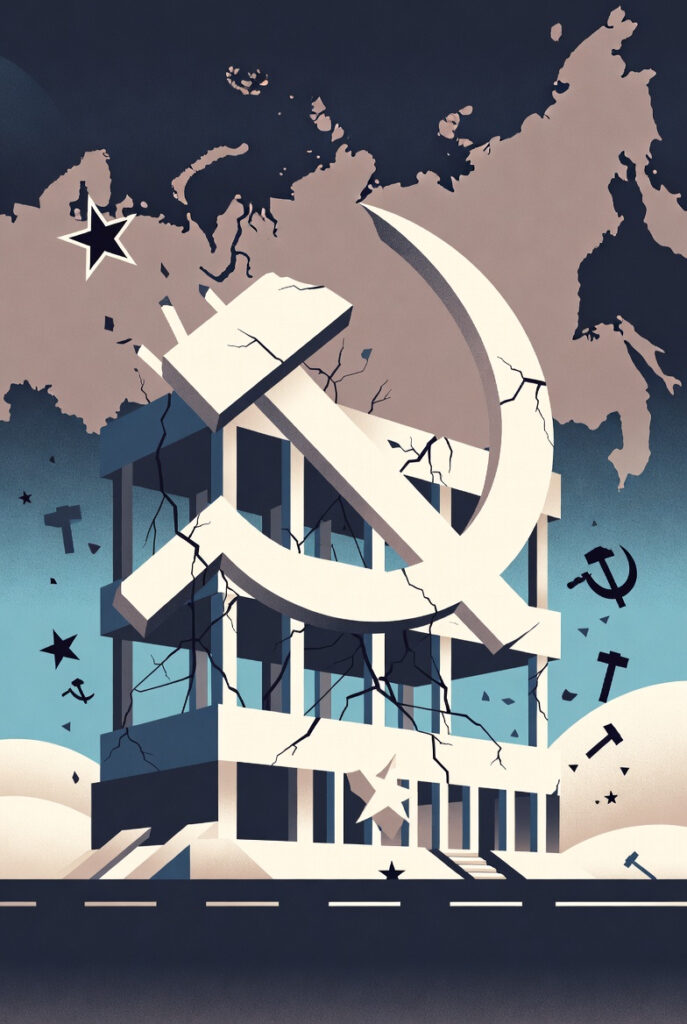
Contemporary left-wing parties, though operating in very different contexts, risk converging toward a similar saturation dynamic. Many have inherited conceptual frameworks, institutional habits, and moral vocabularies that were effective under earlier economic and social conditions but are increasingly misaligned with present complexity. When political programs rely heavily on redistribution without addressing productivity, governance capacity, cultural fragmentation, or technological acceleration, they tend to generate policy overload without systemic coherence. This produces cognitive saturation: slogans replace analysis, moral certainty substitutes for feedback, and dissent is interpreted as betrayal rather than information. Over time, this weakens both electoral viability and governing capacity, creating a cycle in which failure reinforces ideological rigidity instead of prompting recalibration.
-
Willard Van Orman Quine (1908–2000), a major figure in 20th-century analytic philosophy, rejected foundationalism and tightly linked philosophy to empirical…
-
Ray Dalio’s economic framework can be understood as a contemporary, empirical articulation of saturation dynamics within large-scale financial systems. His…
-
The collapse of the Soviet Union can be interpreted, through the Theory of Saturation, as a paradigmatic case of structural and…
-
January 6, 2026 Modern healthcare systems increasingly operate under a paradigm of relentless efficiency. Lean management, standardized protocols, performance metrics,…
-
According to the Collapse (SEA) Model, systemic failure occurs when Stability (S) and Efficiency (E) dominate at the expense of…
-
The Islamic Republic of Iran is undergoing a systemic collapse driven not by a single crisis, but by long-term saturation…
-
Leon Trotsky’s theory of permanent revolution can be read, through the lens of the Theory of Saturation, as a sophisticated…
-
Buddhism offers a distinctive perspective on saturation and collapse, one that operates not at the level of institutional failure or…
Leave a Reply