
According to the Collapse (SEA) Model, systemic failure occurs when Stability (S) and Efficiency (E) dominate at the expense of Adaptability (A), leading to rigidity and eventual breakdown. In Iran’s case, the dictatorship under the Islamic Republic has enforced excessive stability through centralized control, suppressing dissent and maintaining a command economy tied to oil revenues and ideological isolation. This overemphasis on S creates institutional inertia, where policies resist market reforms or international integration. Efficiency is pursued through short-term measures like subsidies and state monopolies, but without adaptability—such as flexible monetary policies or openness to global trade—the system becomes saturated, unable to respond to external shocks like US sanctions or oil price volatility.
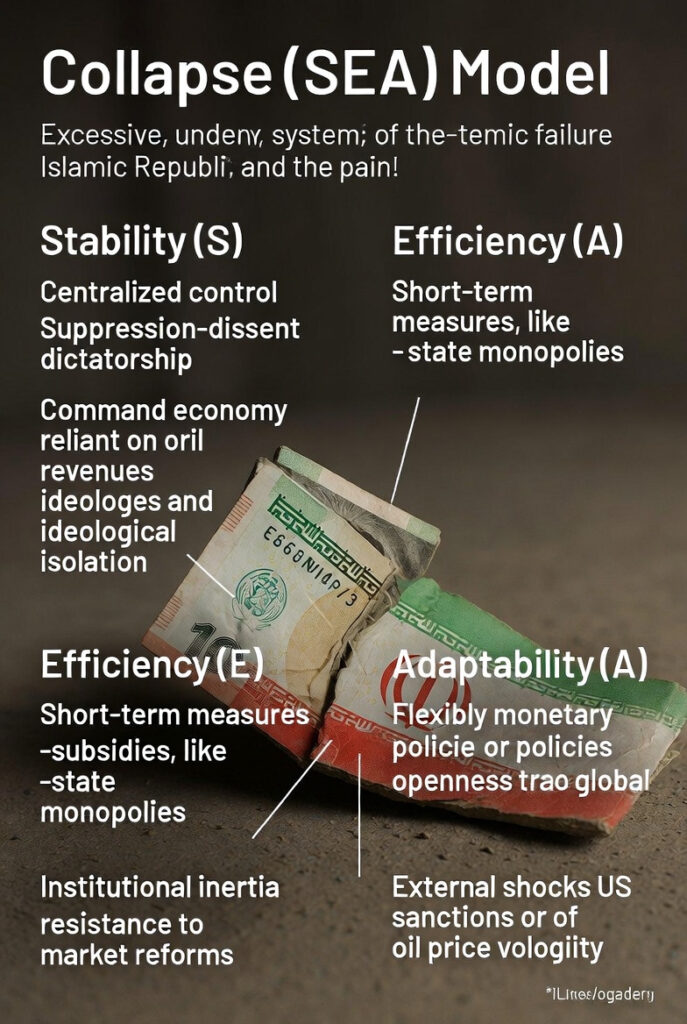
The collapse of the Iranian Rial exemplifies this imbalance, as the currency has depreciated over 90% since 2018, reaching record lows against the USD amid hyperinflation exceeding 40%. Dictatorship’s suppression of Adaptability stifles innovation, foreign investment, and economic diversification, trapping the system in a false equilibrium reliant on repressive controls. Without A to enable renewal—such as democratic reforms or market liberalization—the Rial’s freefall signals full systemic collapse, highlighting a critical gap in authoritarian regimes where political rigidity undermines economic resilience.
-
Willard Van Orman Quine (1908–2000), a major figure in 20th-century analytic philosophy, rejected foundationalism and tightly linked philosophy to empirical…
-
Ray Dalio’s economic framework can be understood as a contemporary, empirical articulation of saturation dynamics within large-scale financial systems. His…
-
The collapse of the Soviet Union can be interpreted, through the Theory of Saturation, as a paradigmatic case of structural and…
-
January 6, 2026 Modern healthcare systems increasingly operate under a paradigm of relentless efficiency. Lean management, standardized protocols, performance metrics,…
-
According to the Collapse (SEA) Model, systemic failure occurs when Stability (S) and Efficiency (E) dominate at the expense of…
-
The Islamic Republic of Iran is undergoing a systemic collapse driven not by a single crisis, but by long-term saturation…
-
Leon Trotsky’s theory of permanent revolution can be read, through the lens of the Theory of Saturation, as a sophisticated…
-
Buddhism offers a distinctive perspective on saturation and collapse, one that operates not at the level of institutional failure or…
Leave a Reply